Fostering Belonging in Asynchronous, Online Courses
Asynchronous courses have the potential to open doors of opportunity for many students by their flexible nature, allowing students to juggle other aspects of their academic, professional, and personal lives. While there are benefits, there are critical design considerations for asynchronous, online courses that are distinct from onsite courses. For example, the lack of physical presence requires a level of intentionality to build students’ sense of community and connection with their peers and their instructors to positively impact their engagement and create a welcoming environment (Delahunty et al., 2014). This resource explores several frameworks and approaches that instructors can apply to foster belonging in asynchronous courses.
Learning Frameworks
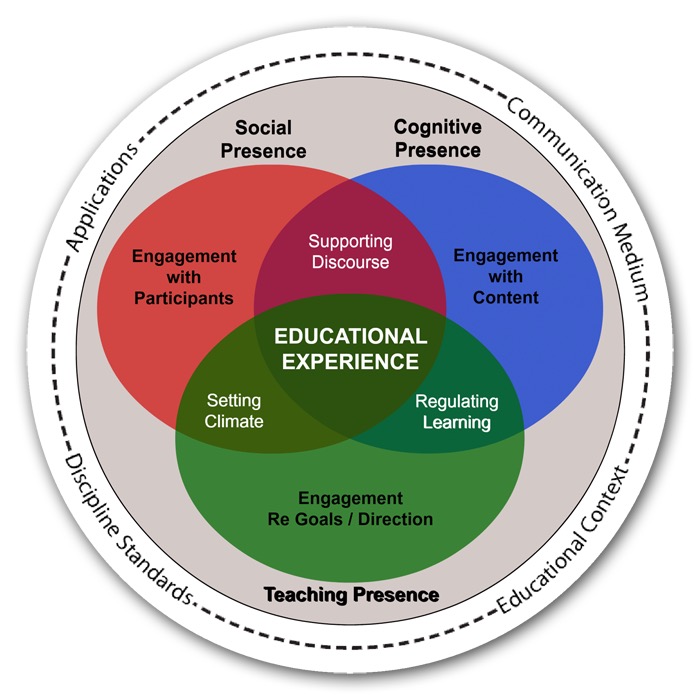
The Community of Inquiry (COI) framework has been applied to a variety of education settings including the teaching of online courses (Garrison et al., 2001). COI has three major components each playing a critical role (from The Community of Inquiry, n.d.):
- social presence: “the ability of learners to project their personal characteristics into the community of inquiry, thereby presenting themselves as ‘real people.’”
- cognitive presence: “the extent to which the participants in any particular configuration of a community of inquiry are able to construct meaning through sustained communication”
- teaching presence: “the design, facilitation, and direction of cognitive and social processes for the purpose of realizing personally meaningful and educational worthwhile learning outcome”
While all components of the Community of Inquiry framework may have applications to cultivating a sense of belonging, social presence can be particularly important for asynchronous courses; several examples of how to create such presence are described in subsequent paragraphs.
Building on the work of Garrison et al. (2001), Peacock & Cowan (2019) modified the community of inquiry model to address sense of belonging and included three influences–trusting, meaning-making, and deepening understandings–at the intersections of each of the three types of presence. Further work by Peacock et al. (2020) investigated sense of belonging among online learners enrolled in postgraduate studies. They found three major areas to contribute to students’ sense of belonging:
- engagement,
- the culture of learning, and
- the support received.
With regard to engagement, students indicated that instructors were critical to their sense of belonging when they demonstrated friendliness and helpfulness and had continual presence in the videos or other media used in the asynchronous courses. Students also commented upon the usage of discussion boards as promoting a sense of belonging, as well as group work experiences which made them feel less isolated.
For culture of learning, students described having access to course materials and being able to share their challenges as learners as positively contributing to their sense of belonging. Instructors posting on the discussion board also humanized the experience for the students. However, when their classmates did not uphold their responsibilities for group or other assignments or gave peer review feedback that was perceived as harmful, students reported decreased sense of belonging.
For support, obtaining feedback from peers on learning challenges, having a variety of engagement approaches beyond reading text (e.g. videos, group projects, etc.) was critical.
Additional scholars have built upon this work to further describe how to foster inclusion and build community in online courses (e.g. Cohn & Plotts, 2021).
Recommendations
- Begin the term with class introductions – To build community from the start of the course, in addition to sharing an instructor welcome video, have students complete an activity where they introduce themselves to the class. Examples include videos or short discussion posts that allow students to introduce themselves.
- Provide a virtual space or “watercooler” where students can ask questions amongst themselves – Set up a space that students can use when they are uncertain about course topics or would like to share resources. Provide guidelines for what they might post and encourage the usage of this forum as an opportunity to connect with classmates.
- Thoughtfully design structured collaborative or pair activities – In some online courses, group work where students must meet synchronously outside of the course might be challenging for different schedules. Consider either pairing students in ways that take into account their schedules or designing them for structured work that involves check-ins and asynchronous engagement. See the Effective Teaming Resource for more information.
- Set classroom guidelines for all asynchronous discussions and moderation – To support positive discourse in asynchronous learning environments, set guidelines for discussion, such as the core rules of netiquette (see below, adapted from Mintu-Wimsatt, 2010). Constructively address any violations to promote a positive environment, by returning to the classroom guidelines. Such guidelines can also be co-created with learners.
- Share airtime.
- Avoid using offensive language.
- Never make fun of someone’s ability to read or write.
- Share tips with other students.
- Be open to differing perspectives.
- Be aware of the university Academic Integrity Policy.
- Reflect before you push the “Send” button and be mindful about what you post.
- Do not hesitate to ask for feedback.
- When in doubt, always check with your instructor for clarification.
References
Cohn, J., and Plotts, C. (2021). How to structure your online class for inclusion. Part I and Part II. Faculty Focus. https://www.facultyfocus.com/author/ff-jenaecohn/
The Community of Inquiry. (n.d.). https://www.thecommunityofinquiry.org/framework
Delahunty, J., Verenikina, I. & Jones, P. (2014). Socio-emotional connections: identity, belonging and learning in online interactions. A literature review. Technology, Pedagogy and Education, 23 (2), 243-265.
Garrison, D. R., Anderson, T., & Archer, W. (2001). Critical thinking, cognitive presence, and computer conferencing in distance education. American Journal of Distance Education, 15(1), 7-23.
Mintu-Wimsatt A. (2010). Netiquette: Make it part of your syllabus. Journal of Online Learning and Teaching, 6(1):264.
Peacock, S., Cowan, J., Irvine, L. & Williams, J. (2020). An Exploration Into the Importance of a Sense of Belonging for Online Learners. International Review of Research in Open and Distributed Learning, 21(2), 18–35. https://doi.org/10.19173/irrodl.v20i5.4539
Peacock, S., & Cowan, J. (2019). Promoting sense of belonging in online learning communities of inquiry in accredited courses. Online Learning, 23(2), 67-81. https://doi.org/10.24059/olj.v23i2.1488