Syllabus Resource Library
Overview
The syllabus is a foundational document in teaching and learning environments that can be designed to support student learning and success. Syllabi serve a variety of purposes, not limited to:
- Welcoming students to the course
- Communicating key information
- Setting expectations and establishing transparency
- Organizing course content in meaningful ways
- Sharing resources to support student learning
Because of the importance of the syllabus, the Institute partnered with student pedagogical partners who are trained to give feedback on teaching and support instructional efforts to co-develop this instructor syllabus resource library. Included in the resource is guidance on three types of syllabi: traditional, graphic, and video-based.
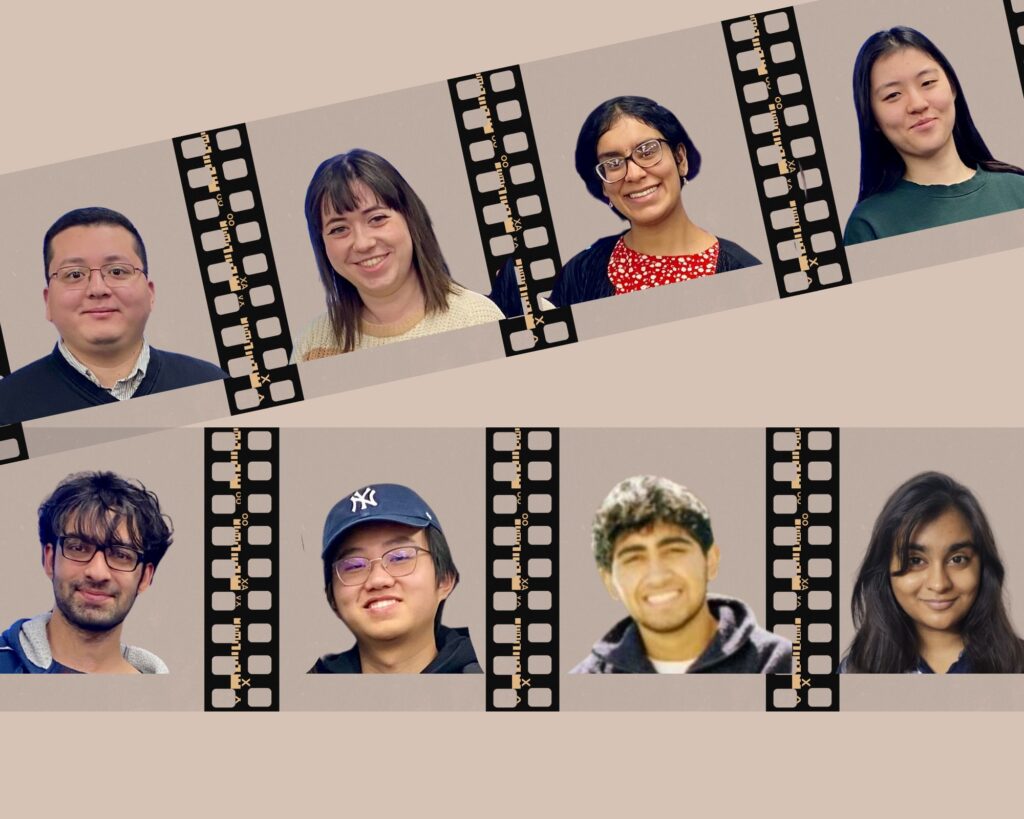
The Student Co-Design Team
How to Use the Resource
- Read the Indicators of an Effective Syllabus document linked below for general guidance on developing course syllabi.
- Review any existing syllabi developed for your course(s). If designing a new course, consider the content you will add to your syllabus, format, and tone.
- Decide which types of syllabi beyond traditional can support student engagement in your course.
- Use the frameworks included below to develop or refine syllabi.
- Revisit the Indicators of an Effective Syllabus to ensure that your syllabi follow the suggested recommendations. We encourage instructors to make syllabi accessible to students in their course at minimum a day prior to the start of classes.
- Contact TeachingInstitute@rutgers.edu to schedule a 1:1 consultation to obtain additional feedback on your course syllabi.
Download (Word doc): Indicators of an Effective Syllabus
-
Overview
A requirement of most college-level courses, this multi-page document provides comprehensive information such as course and instructor information, course policies, the course schedule, and learning resources.
The Co-design Process
- The student co-design team brainstormed information to include on a traditional syllabus in additional to pitfalls to avoid.
- TIIP staff members synthesized this information, included recommendations in the Indicators of an Effective Syllabus document and drafted a framework for a traditional syllabus. TIIP obtained additional feedback from the advisory committee and student co-design team and performed another round of revision to develop the framework linked below.
-
Overview
A graphic syllabus is typically a short one-page document that is visually appealing and contains key course information. There is value in distributing a graphic syllabus in addition to the traditional syllabus (Nilson, 2002). Students provided with a graphic syllabus were found to have positive perceptions of certain course elements (Wickline et al., 2025), preferred it over the traditional syllabus (Mikhailova, 2018), and had no differences in information retention compared to the traditional syllabus (Kaur, 2021).
The Co-design Process
- The student co-design team reviewed and discussed several examples of graphic syllabi found online. They analyzed the strengths and weaknesses of each sample and identified the main elements including content and format they would find valuable in a graphic syllabus.
- TIIP staff members next drafted a sample graphic syllabus from these recommendations which can be downloaded below and adapted.
-
Overview
Creating a short video syllabus tour can significantly enhance students’ understanding, engagement, and connection at the start of a course. Research shows that instructor-generated video content helps to humanize the instructor (Pacansky-Brock, Smedshammer, & Vincent-Layton, 2020) and helps the students to see value in the course (Draus, Curran, & Trempus, 2014). A video syllabus transforms a traditionally static document into a more active and engaging resource (Kerrigan & Bifulco, 2023). In addition, this ensures information is accessible in multiple formats, promoting inclusivity (CAST, 2024).
The Co-design Process
- The student co-design team watched sample video-based syllabi. They identified the main elements including content and format.
- TIIP staff members integrated recommendations based on the student co-design team’s feedback to support instructors in designing video-based syllabi.
-
Syllabus Type
Description
Advantages
Implementation
Traditional Multi-page document typically referred to when describing a syllabus Provides a detailed overview of course information and additional resources Post to Canvas using the “syllabus” feature; engage students with it in a meaningful way (e.g. administer a low-stakes assessment, invite students to annotate the syllabus) Graphic A one-page or short document with visual elements that highlights major course information Can communicate syllabi concisely; can be visually engaging to students and less daunting than traditional syllabi Post to Canvas; can also be provided to students during the first week of classes to highlight key topics as well as used to advertise a course Video-based A short video overview of the syllabus Allows for multimodal review of the syllabus; can be useful to provide to students who missed early classes due to the drop/add period Post to Canvas and implement watching the recording and answering questions as a course assignment -
CAST (2024). Universal Design for Learning Guidelines version 3.0. Retrieved from https://udlguidelines.cast.org
Draus, P. J., Curran, M. J., & Trempus, M. S. (2014). The influence of instructor-generated video content on student satisfaction with and engagement in asynchronous online classes. Journal of Online Learning and Teaching, 10(2), 240-254. https://jolt.merlot.org/vol10no2/draus_0614.pdf
Gurung, A. R. (2022). An invitation to class: Introducing the syllabus snapshot. The Teaching Professor: https://www.teachingprofessor.com/topics/preparing-to-teach/syllabus/an-invitation-to-class-introducing-the-syllabus-snapshot/
Kaur, Angel W. (2021). “Dope syllabus”: Student impressions of an infographic-style visual syllabus. International Journal for the Scholarship of Teaching and Learning, 15(2), 1-16. https://eric.ed.gov/?id=EJ1341918
Kerrigan, J., & Bifulco, C. (2023). Syllabus 2.0: Using videos to make the syllabus active. College Teaching, 72(4), 369–378. https://doi.org/10.1080/87567555.2023.2208817
Mikhailova, E. A. (2018). Enhancing soil science education with a graphic syllabus. Natural Sciences Education, 47(1), 1-6. https://doi.org/10.4195/nse2017.12.0025
Nilson, L. B. (2002). The graphic syllabus: Shedding a visual light on course organization. To Improve the Academy, 20(1), 238–259. http://dx.doi.org/10.3998/tia.17063888.0020.018
Pacansky-Brock, M., Smedshammer, M., & Vincent-Layton, K. (2020). Humanizing online teaching to equitize higher education. Current Issues in Education, 21(2), 1–16. https://cie.asu.edu/ojs/index.php/cieatasu/article/view/1905
Wickline, V. B., Ford, C., Gurung, R. A. R., & Appleby, D. (2025). Can syllabus snapshots predict student perceptions of course and instructor? Scholarship of Teaching and Learning in Psychology. Advance online publication. https://psycnet.apa.org/doi/10.1037/stl0000432