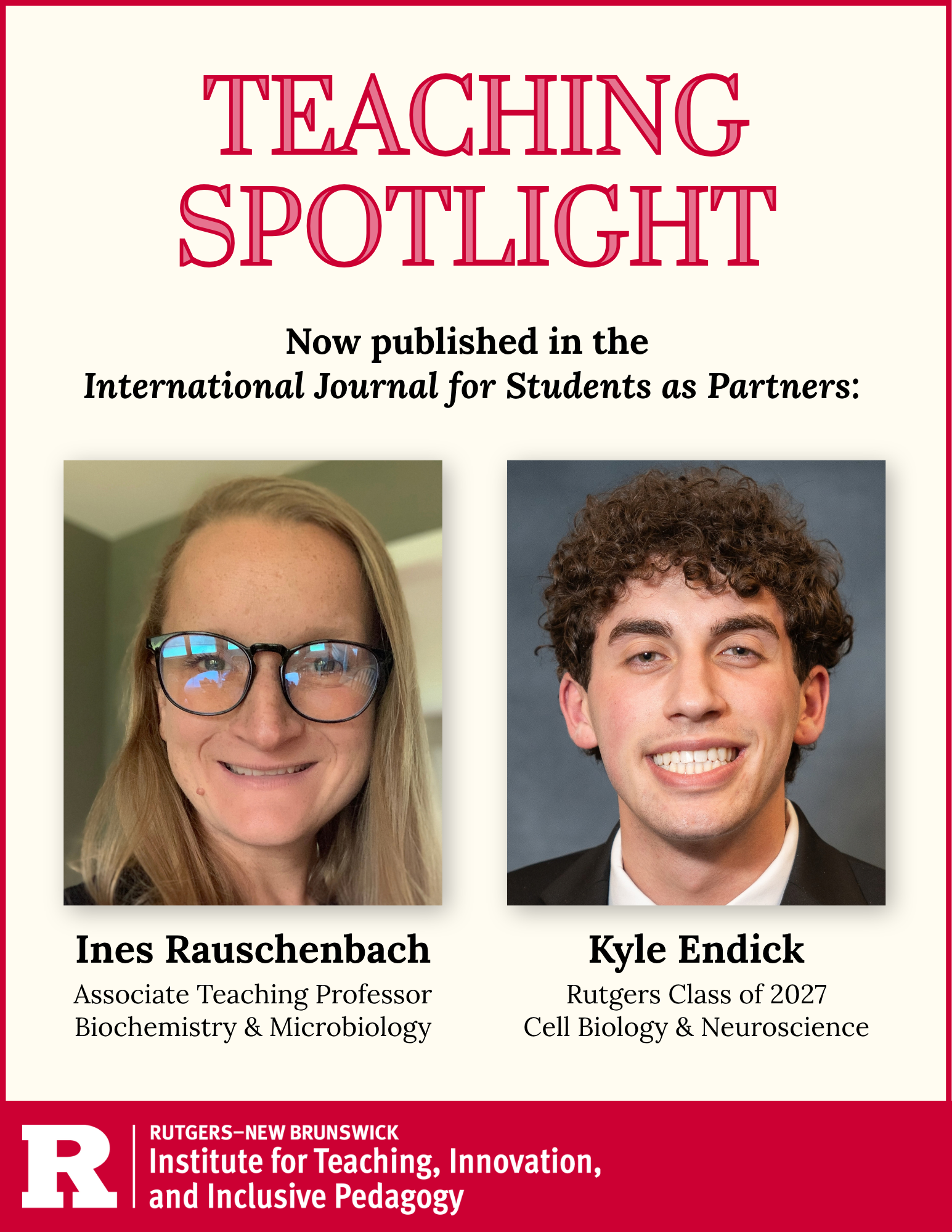
When Dr. Ines Rauschenbach opened the doors of her 120-student Introduction to Microbiology course to observation by undergraduate student Kyle Endick, both stepped into unfamiliar territory. Rauschenbach, an Associate Teaching Professor in the Department of Biochemistry and Microbiology, wondered how a student without a microbiology major could give her meaningful feedback on her course. Endick, then a junior studying cell biology and neuroscience, had just joined the inaugural cohort of TIIP’s Student Pedagogical Partner fellowship.
It was this fellowship that brought the two together for a structured observational partnership. As part of the fellowship, students pair directly with Rutgers–New Brunswick instructors to observe class sessions and offer their perspectives on the classroom experience to help instructors achieve their specific pedagogical goals.
What began as a semester-long observational partnership grew far beyond the scope of their fellowship requirements. Driven by a shared passion for enhancing student learning, Rauschenbach and Endick went the extra mile to co-author a reflective essay on their collaboration called “Reflecting Beyond the Podium of a Large Course: Student Partner-Academic Staff Collaboration at a Teaching Institute”. Joined by TIIP Director Dr. Tracie Addy, they published reflections on their experiences in the International Journal for Students as Partners—an incredible achievement that highlights the transformative potential of student-faculty collaboration.
Uncovering Insights in the Classroom
With TIIP’s training and guidance, Endick conducted structured observations of Rauschenbach’s class throughout the Spring 2025 semester, using the Protocol for Advancing Inclusive Teaching Efforts (PAITE)—a data-driven tool designed to capture real-time classroom engagement and inclusive teaching practices.
Because Endick was not enrolled in or being graded on Rauschenbach’s course material, he brought a neutral, objective lens to the learning environment, uncovering several key takeaways throughout his observations.
Affirming What Works in the Classroom
Endick’s PAITE data offered meaningful validation for Rauschenbach’s gradual shift away from traditional lecture-style delivery. Over several years, Rauschenbach had intentionally redesigned her course to integrate active learning approaches—such as mini-lectures, real-time polling questions, and case-based think-pair-share discussions. Seeing these data-backed observations confirmed that her ongoing efforts to create an interactive, student-centered classroom were successfully resonating with learners.
A Small Change to Enhance Belonging
Beyond affirming the course structure, Endick provided specific, actionable insights that end-of-semester course evaluations simply can’t capture. For instance, while Rauschenbach frequently used warm affirmations to encourage responses, Endick noted that she rarely addressed students by name—an insight that inspired her to intentionally incorporate students’ names to foster a deeper sense of belonging in large lectures.
A View from Every Corner of the Room
To capture a holistic view of the student experience, Endick sat in different locations during each visit. Intentionally sitting in a different spot during each visit reshaped how Endick understood himself as a learner in ways he had never previously considered. Observing from an outsider’s perspective transformed a common observation—that back-row students are less engaged—into a more personal insight about how physical placement can subtly influence focus and active participation.
The Power of Student Voice
For Rauschenbach, one of the most surprising takeaways was how valuable Endick’s non-microbiology background proved to be. Rather than getting bogged down in technical terminology, Endick focused entirely on pacing, clarity, and accessibility.
“Despite my initial concerns, my student partner’s lack of a microbiology major added value to their feedback…. Ensuring that I did not unintentionally assume prior knowledge or use jargon that could alienate students… Integrating a student partner into my course was a transformative experience. It offered a powerful reminder that teaching is not a solitary act but a collaborative, reflective, and evolving process.”
— Dr. Ines Rauschenbach, Associate Teaching Professor
For Endick, the experience demonstrated that giving students a hand in shaping classroom environments builds a foundation of mutual respect and long-term progress.
“Through this partnership, I learned that instructional growth is a reflective process that unfolds over time. Even though my feedback and suggestions to my partners may not have yet taken effect, it’s the conversation that matters. Academic staff develop new perspectives, modify their syllabi, and take incremental steps towards educational change… Their success depends on a shared openness: the willingness to listen and the opportunity to be heard.”
— Kyle Endick, Rutgers Senior (’27)
Scholars in Pedagogy
While TIIP provided the framework and observation tools, Rauschenbach and Endick’s decision to document and publish their findings was entirely self-directed. Their co-authored essay, “Reflecting Beyond the Podium of a Large Course: Student Partner-Academic Staff Collaboration at a Teaching Institute,” offers educators, students, and academic leaders alike an inspiring example of a meaningful pedagogical partnership.
Their collaboration demonstrates that when instructors open their classrooms to student feedback, teaching ceases to be a solitary act at the podium and becomes a continuous, reflective dialogue that elevates the learning experience for the entire school community. We applaud them for their outstanding achievement and celebrate their leadership in shaping more inclusive learning environments.